
A municipality has an aging wastewater lift station. The pumps have reached the end of their life expectancy and the controls are dated, as well as the access hatch is deteriorated. The concrete wet well is sturdy and solid.
Should the station be completely removed? Not necessarily. It is more important to consider whether the infrastructure in place can support an advanced system of pumping without compromising capacity in the future and reliability or maintenance accessibility.
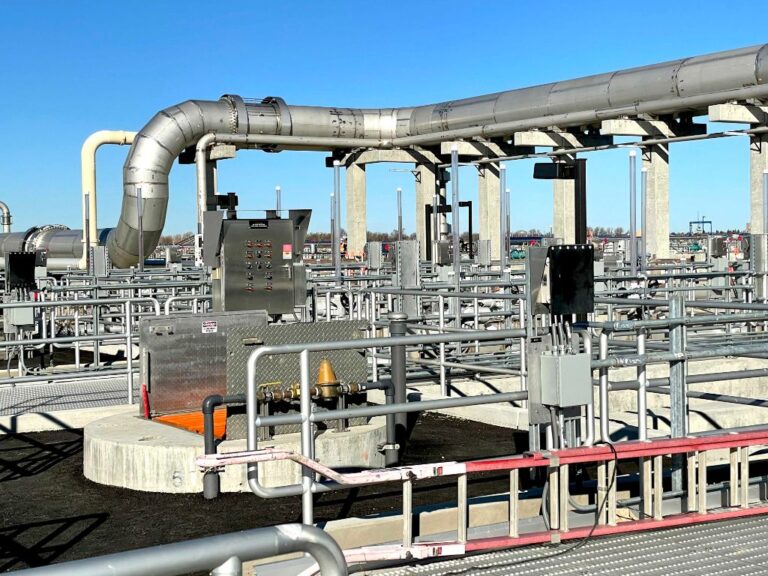
Image credit: romtecutilities.com
A carefully engineered pump station retrofit can preserve valuable infrastructure while replacing components that no longer meet operational requirements.
Start With the Structure Nobody is Trying to Replace.
The wet well is usually among the most expensive and disruptive components to replace, as it’s submerged, connected to existing piping and is essential for wastewater collection.
If the concrete structure remains in good condition, retaining it could make it easier to dig and build.
The degrading of the area around the access hatch might cause problems with this decision. Romtec Utilities says that wet well hatches are often replaced in retrofits. Instead of affixing a hatch to cement that is degrading, replacing the whole top layer might be a more durable option. This will allow for greater access to the structure as well as prolong its utility, without having to replace the entire structure as well.
A new pump improves the way engineers work.
Take a look at a neighborhood that has experienced a significant increase in population since the construction of the lift station. It’s possible that existing pumps are no longer adequate to handle the increase in flows of wastewater.
A change to the pumping station may be accompanied by higher horsepower pumps. However, the selection of equipment is not independent of the system in which it is located. For pumps that are more powerful there is a possibility that you will need to make changes to the discharge elbows or pipe. You might also have to replace electrical controls or valves.
Engineers must also think about the hydraulic requirements of the system. This includes flow and the total dynamic pressure. A larger pump installed without checking these parameters can cause problems with operation rather than addressing these. Making plans for future capacity at the time of initial design makes later expansion much easier.
Check that the waste water is flowing during construction
Retrofitting a pump station for wastewater is a particular challenge that isn’t encountered by other projects. The station could need to be operational while construction is underway.
When contractors aren’t busy they continue to receive wastewater. In the case of a project it is possible that temporary bypass pumps will be required to keep service while existing equipment is taken away and new components are put in place.
Romtec Utilities embraced this challenge at the Federal Law Enforcement Training Center, Brunswick, Georgia.
The project involved replacing two older wastewater lift stations and ensuring the operations of the facility. Specific engineering for the site packages, replacement systems for packaged equipment, and bypass pumping strategies were used to allow for the existing station footprints and operational needs. This is a good example of how important it is to consider the construction sequence prior to constructing.
If replacement is the best alternative
Some stations may not be suitable for rehabilitation. If the sewer lift station is in need of a replacement because of a damaged well, structural problems or significant changes to the hydraulic requirements, it could be better to replace instead of modify.
In making a final decision, it is crucial to take into consideration the structural integrity of the building, its compatibility with equipment, accessibility to construction sites, service continuity and long-term needs. Romtec Utilities begins retrofit and replacement projects by identifying which elements will remain and which ones require replacement.
The company will then create specific engineering plans for the site along with budget estimates and initial designs. Prefabricated components are also useful in arranging installation and decreasing some on-site requirements.
The Project is not Completion until the Pumps Have Beginning
Modern lift stations must operate as an integrated system. Prior to returning it back to regular service, startup testing and commissioning will help ensure that the controls, pumps, as well as the equipment that is associated with them, are in accordance to the design approved.
Manuals for maintenance and operation and training of operators, are essential. Maintenance personnel need to understand the latest equipment, operating procedures and documentation before taking responsibility for the station.
A successful retrofit preserves the infrastructure that is still valuable as well as addressing the weaknesses that led to modernization being necessary.
For facility owners and municipalities it is important to look beyond immediate repairs. The strongest project is one that integrates the new equipment with existing structures, provides essential service during construction, and prepares the pumping system to last for years of continual operation.